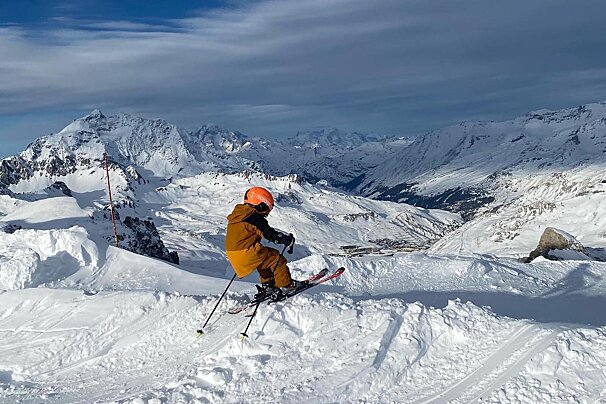
In European ski resorts the pistes are kept as safe as is possible from avalanches by the 'Securité des Pistes' (piste rescue services).
Avalanche Safety in Tignes
Discover the top Tignes avalanche safety techniques
As such, there is very little danger from avalanches on the marked runs in resort, but that's not to say an avalanche never hits the pistes, because unfortunately sometimes they do. However, as soon as you leave the pistes the off-piste area is no longer secured, and skiers and snowboarders find themselves in potential avalanche terrain.
It's entirely the decision of the individual to enter this terrain, and unlike in Canada and North America, you're completely free to do so. With the growing popularity of skiing and snowboarding and the advances of ski and snowboard tech, more and more people are venturing into off-piste terrain, sometimes before they fully understand the potential danger.
Avalanche risk classifications

Most natural avalanches occur during the spring on south facing slopes when the sun warms the snow up and causes 'point release' avalanches. In general these are not a significant danger as there are usually no people involved; the snow is wet and heavy and skiers or snowboarders tend not to ride it. These avalanches also move quite slowly and start from an individual point, growing in size as they move down the hill.
Most avalanche accidents by contrast happen in the cold months of December, January and February on north facing slopes. This is when the powder is best and the traffic in the off-piste is heaviest. It's also when most slab avalanches occur. In 90% of avalanche accidents, the victim or someone in the victim's party triggers the avalanche and 90% of these accidents involve a slab avalanche. Slab avalanches occur when a layer of snow that is well bonded breaks free from the layer below, and the well bonded layer slides away breaking up into large blocks of snow and ice as it makes its way down the hill.
Avalanche accidents can occur without any obvious warning, and even the most practised back country experts can get caught out. To help skiers and snowboarders make an informed decision about the risk of avalanches there is an "Avalanche Hazard Rating" system. This is marked at the bottom of the slopes by coloured flags; yellow, yellow and black and black.
These flags represent a score of one to five explaining the danger posed by the instability in the snow. he hazard indicator classifies the immediate danger that is present from an avalanche. The scale is set by the resort using detailed avalanche bulletins for Tignes and the surrounding areas provided by Météo France from December to April.
The app Strava also gives a good indication of which slopes are in the potential avalanche risk range, however it does not guarantee they are safe. Regular avalanche bulletins are provided by Météo France, and English website Pistehors.com often provide up to date snowpack and avalanche information.
Although it by no means guarantees off-piste safety, following the Hazard Rating System can reduce the chances of being involved in an avalanche accident. It does not however mean that an avalanche will not occur. The following table outlines the flag based system and gives an introduction on how to interpret avalanche risk:
| Hazard Rating 1/5 - Low |
| Stability: The snowpack is generally well bonded and stable Activity: Triggering is possible only with high additional loads[2] on a few very steep extreme slopes[4]. Only a few small natural[6] avalanches (sluffs) possible Off-piste activities: Virtually no restrictions on off-piste and backcountry skiing |
| Hazard Rating 2/5 - Moderate |
| Stability: The snowpack is moderately well bonded on some[1] steep[3] slopes, otherwise generally well bonded Activity: Triggering is possible with high additional loads[2], particularly on the steep[3] slopes indicated in the bulletin. Large natural[6] avalanches not likely Off-piste activities: Generally favourable. Routes should be selected with care |
| Hazard Rating 3/5 - Considerable |
| Stability: The snowpack is moderately to weakly bonded on many[1] steep[3] slopes Activity: Triggering is possible, sometimes even with low additional loads[2]. The bulletin may indicate many slopes which are particularly affected. In certain conditions, medium and occasionally large sized natural[6] avalanches may occur Off-piste activities: Should be carried out by experienced individuals with significant avalanche training and those who posses understanding and evaluation of potential hazards. Certain steep slopes should be avoided |
| Hazard Rating 4/5 - High |
| Stability: The snowpack is weakly bonded in most[1] places Activity: Triggering is probable even with low additional loads[2] on many steep[3] slopes. In some conditions, frequent medium or large sized natural[6] avalanches are likely Off-piste activities: Restricted to low-angled slopes; areas at the bottom of slopes may also be hazardous |
| Hazard Rating 5/5 - Very High |
| Stability: The snowpack is generally weakly bonded and largely unstable. Activity: Numerous large natural[6] avalanches are likely, even on moderately steep terrain. Extensive safety measures (closures and evacuation) are necessary Off-piste activities: No off-piste or back country skiing or travel should be undertaken |
[1] Generally described in more detail in the avalanche bulletin (e.g.altitude, slope aspect, type of terrain, etc.)
[2] Additional load:- High - e.g. group of skiers, piste machine, avalanche blasting. Low - e.g. skier, walker
[3] Steep slopes: slopes with an incline of more than 30 degrees
[4] Steep extreme slopes: those which are particularly unfavourable in terms of the incline, terrain profile, proximity to ridge, smoothness of underlying ground surface
[5] Aspect: compass bearing directly down the slope
[6] Natural: Without human assistance
With all of this in mind, once on the hill it is important to remember the following:
- Avalanche accidents often occur on steeper slopes. 30 to 40 degree slopes are prime spots for avalanche accidents. In practical terms this means a slope that is equivalent to a red or black piste. Slopes below this range are usually not steep enough for the snow to be able to slide and above this range the snow tends not to build up in significant amounts as the slope is too steep for the snow to form a slab layer and usually too steep to ski.
- Slab avalanches often occur on the windward side of the hill. Snow is blown from one side of the hill to the other. This "wind loading" causes large amounts of snow to be deposited in one place. This snow bonds well to itself but not to the snow below setting up perfect conditions for a slab avalanche.
- Slab avalanches often fracture along convexities. Where the slope rolls from flat to steep, the snow is under the most stress as the change in gradient causes it to pull itself apart, this is often where avalanches begin.
- The danger may come from the terrain below. Even a small avalanche can knock a skier or snowboarder off their feet and if there are trees, cliffs or lakes below, the avalanche itself may not be fatal but the impact or fall may be.
- Only expose one person to danger at a time. Moving around the off-piste in a small manageable group and only traversing, climbing and skiing potentially dangerous areas one at a time will reduce the risk of triggering an avalanche and make a rescue easier if one does happen.
Avalanche FAQs

Here are a selection of frequently asked questions relating to avalanches that has been compiled from a range of sources; our own mountain experiences, chatting with the experts, your feedback, plus translations of French articles and websites. Some of the information appears in the above sections but here you will find more detail. We have put this resource together to assist you in learning more about avalanches.
Are avalanches predictable?
Avalanches are not easy to predict. Some avalanche paths are only active once every few hundred years; others are active in almost every storm. However, we can predict avalanches to a certain extent. To quote a well-known professional, Bruce Tremper, "they happen at particular times and in particular places for particular reasons". There are always observable signs of instability before an avalanche happens - recognised all too often after the fact: in 90% of all avalanche accidents, the avalanche trigger is the victim (or someone in the victim's party) and 90% of the time, a slab avalanche is involved.
Are there more avalanches in spring?
Spring conditions may be the time of year when there are the most avalanches, but once a regular cycle of melting and freezing sets in, predicting the stability of the snowpack is more evident than during the cold winter months. During the freeze phase, the snowpack is at its strongest. Once free water has seeped into the snowpack, through rain or melting, then it can turn into ice when the temperatures go below freezing - the ice forms a sort of 'skeleton' that holds the snowpack together. Melting during the day and freezing at night is a classic springtime process. In these conditions, after a good freeze at night, the slopes are very stable first thing in the morning. Then, as the sun rises (warming east facing slopes first), the ice skeleton holding the snowpack together melts and the slope eventually becomes much less stable.
In melting and freezing conditions, the snowpack is at its strongest during the freeze phase, then at its weakest during the melt phase. In between these phases, the skiing conditions can be tremendous as long as people haven't been there late the day before. Get on the slope as the first few centimetres are beginning to melt and then get off. When melting penetrates more than 5cm, the slope has started to become unstable and you will start to break through the crust - this alone can lead to injury. Making the right calls in these conditions takes experience - but that is part of the adventure.
Can I get out of the way of an avalanche?
Dry slab avalanches typically reach a speed of 90-130km/h within about five seconds after they fracture. Wet avalanches usually travel much more slowly, around 30km/h.
Can screaming and yelling start an avalanche?
We really don't think so. However if conditions are that unstable, why would you be screaming and yelling out there in the first place - unless it's for help. In our opinion, an increase in the volume of your individual and collective voices is inversely proportionate to the level of your awareness of potential hazards. Explosives that are used for avalanche control are powerful and it's the shock wave produced by the blast that sets off the avalanche.
How can I begin to evaluate if the snow is stable or if it can fail?
Look and listen: You can understand a lot just by watching and listening.
- Look: Recent avalanche activity is the most practical way to begin to evaluate the snowpack stability. If all of the east facing slopes around you have evidence of recent avalanche activity and you are about to set out onto the only east facing slope that has not avalanched, this is clearly not a good idea.
- Listen: When you hear and feel 'whoomphing', the snowpack is collapsing beneath you. The snowpack is telling you that it's unstable. If you're on a steep slope, it will be more than telling you, it will be releasing at the same time as the 'woomph'. First thing in the morning after a snowstorm, snowpack stability is often uncertain. It's a good idea to start out on low-angle slopes - whilst constantly looking around to see if there are any consistent 'themes' in the recent avalanche activity (slope aspects, depth of slabs, steepness of slopes etc.) For example, if you notice that many northwest facing slopes have avalanched, this is a theme and a clue that there is significant instability on those slopes. Whether or not it is advisable to venture out onto those slopes depends on many other factors ranging from group dynamics and skill level to recent weather events, (e.g. rapid temperature fluctuations), steepness of slopes and the terrain below. Never base evaluation of stability on only one clue.
What should I do if I'm caught in an avalanche?
Depending on the situation there are a number of things that you should try to do:
First, once the snow starts moving, try to get off the snow that is breaking up as soon as possible. You can get out of an avalanche early if you're close to the fracture line or close to the edge (or flank) especially if the snow isn't too broken up. If you're close to one of these edges, do everything you can to move towards it. If the fracture line is just above you, try to allow the snow to move past you. For example, if you're on skis, side-step up, grab a tree, do whatever you possibly can. If the fracture line is way above you and you can't make it to the side fast, point your skis or snowboard downhill, say a prayer if you're so inclined, go like hell and try to get out of the way lower down.
There is a lot of controversy about what you should do if you are caught in the turning snow. Some say swim (since a person is about three times denser than moving avalanche debris) and others say roll. The most important thing is to keep your mouth free of snow especially when the snow comes to a stop; an air-pocket is essential to your survival in what amounts to a concrete tomb. It's almost impossible to dig yourself out of an avalanche. Most people suffocate within 15 minutes if they haven't actually been killed by the avalanche (approximately 10%). Before it stops, you can try pushing a hand upwards. Visual clues are the fastest way for rescuers to find you, but then, you may not be able to make an air-pocket.
(These tips were provided by Henry Schniewind of Henry's Avalanche Talk - helping you make informed decisions. Henry's interest in avalanches started with a close call in the French Alps, after which he went back to the United States to study avalanche forecasting and continue outdoor pursuits, but the obsession with Europe remained and pretty soon he returned to France. Henry is a fully certified ski instructor (French Diploma), has a degree in international business and over ten years of professional experience in the mountains.)
What kind of weather produces avalanches?
Wind is the most common cause of acute instability. Wind can deposit snow 10 times faster than snow falling during storms. Wind erodes snow from the upwind side of obstacles and deposits snow on the downwind (lee) sides. We call this "wind loading".
The added weight from this "wind loading" also causes avalanches. If the weight of new snow is added faster than a buried weak layer can adjust to its load, then it fractures and forms an avalanche. Rapid warming can also cause dry avalanches but this is a much rarer occurrence.
Rain or melting of the snow surface can also cause avalanches. For instance, rain on new snow almost instantly causes avalanches. Strong sun or warm temperatures can also cause melting of the snow and creates wet avalanches. Large wet avalanches occur because of a decrease in strength of a buried weak layer as a result of water dissolving the bonds between the snow grains.
But wind, snow or rapid warming do not always produce avalanches. It depends on the condition of the pre-existing snow and the conditions during the storm. With very stable pre-existing snow, even heavy, new snow with wind can bond well and be perfectly safe in the right conditions.
What kind of avalanche is most dangerous?
Dry slab avalanches account for almost all avalanche fatalities. In the northern hemisphere, these accidents happen in winter conditions (December to mid-March) and most often on north-facing slopes.
Once I'm out there, how can I reduce the odds of getting caught in an avalanche?
Go one at a time on slopes that are questionable, have an escape route planned in your mind, stop at islands of safety and don't bury and kill people in the group below you. Windward slopes and ridges especially, are the safest routes to travel on (but be careful of cornices - you can't see where they overhang when you are on top of them on the ridge). Thick trees are safer, but once the trees become sparse enough to get some good turns in, you are back in potential avalanche terrain. Finally, if things look really nasty, go back the way you came... if that is not also suspect.
Isn't it most dangerous in spring when there are more avalanches?
Spring conditions may be the time of year when there are the most avalanches, but once a regular cycle of melting and freezing sets in, predicting the stability of the snowpack is more evident than during the cold winter months. During the freeze phase, the snowpack is at its strongest. Once free water has seeped into the snowpack, through rain or melting, then it can turn into ice when the temperatures go below freezing - the ice forms a sort of 'skeleton' that holds the snowpack together. Melting during the day and freezing at night is a classic spring process. In these conditions, after a good freeze at night, the slopes are very stable first thing in the morning. Then, as the sun rises (warming east facing slopes first), the ice skeleton holding the snowpack together melts and the slope eventually becomes much less stable.
Is the slope safe after an avalanche has gone?
Usually it's safe. But there are a number of things to watch out for: multiple avalanche starting zones ('hang fire') looming above, dense snowfall, hard wind. If there is rapid melting going on, then there's a good chance of another avalanche coming down. It's a hard call, especially if you are going to rescue someone.
I ski on the piste, why should I be bothered about avalanches?
Many of the accidents resulting in deaths have occurred right next to the piste, due to ignorance. They could therefore have been avoided. If you're a good skier or snowboarder who mostly skis on the piste and you play around next to the piste, then you are a prime candidate for an accident. The same goes for climbers: statistics show that the typical victim of an avalanche is a male in his mid-late 20's, has a good level of knowledge about skiing, boarding or climbing, but very little knowledge about avalanches.
How long can you live under the snow?
People die quickly from carbon dioxide poisoning, because their carbon dioxide builds up in the snow around their mouths. Statistics show that about 90% of avalanche victims can be recovered alive if they are dug out within the first five minutes. However, after 45 minutes only 20-30% are still alive and after two hours almost no one is alive.
How do I judge if a slope is 'dangerous'?
Here are a few things that you should look for systematically each time you go out onto a slope (this list is not exhaustive, but it covers the essentials):
- Steepness: Almost all avalanches occur on slopes between 35 and 45 degrees. An 'expert' slope at a ski resort is usually around 35 degrees maximum.
- Anchors: Trees and rocks that stick up through the snowpack can help to hold the snowpack in place. But the anchors need to be fairly thick to be effective. For instance a thick, mature grove of evergreen trees anchor the slab quite effectively while a sparse grove of trees has very little effect.
- Aspect with respect to wind: Recently wind-loaded, steep slopes are almost always very dangerous while recently wind-eroded slopes are usually fairly safe.

There are various pieces of off-piste equipment available to skiers and snowboarders. The bare minimum that a person must carry with them is a transceiver, a shovel and a probe but there are some other supplementary options available too.
You can read more in our avalanche safety equipment guide.
Avalanche survival, search and rescue

The best way to be prepared when going off-piste or entering the back country is to do an avalanche awareness course provided by local mountain guides.
Ideally, avoiding potentially dangerous terrain and adhering to good off-piste practise will mean that an avalanche accident is never experienced. But if the worst happens and an avalanche occurs there are search and rescue techniques that can be employed and practises that can be used to increase the chances of surviving.
When a person is taken in a slide, it's essential that they try and stay on the surface of the moving avalanche. In many cases the victim has no control of their direction or orientation as the power of the avalanche is too great. However, if possible the skis should be released and poles should be dropped. To make this easier it is important not to use the wrist straps on poles when skiing off-piste.
Without this equipment weighing the victim down, they should fight to stay on the surface of the moving snow, and if buried try to create an air pocket around the face to allow adequate oxygen reserves during the rescue.
A person buried by an avalanche, who has not been killed by the trauma of the slide, will typically have a 15 minute survival window before they succumb to asphyxiation due to re-breathing their own expelled carbon dioxide. Although the emergency services in the Alps are highly trained and efficient, they cannot usually arrive at an avalanche accident site quick enough to save a victim.
Shovels and probes are essential when travelling in the backcountry. Without a probe to accurately locate a victim and a shovel to move the snow, recovery times increase massively and a victim buried under a metre of snow will take almost an hour to recover. It's often possible to buy a beeper, shovel, probe and backpack at a discounted price when they are purchased together. With this equipment a group will be able to carry out a self-contained rescue and should be able to recover a buried friend in under ten minutes.
More inspiration...
Find out more by reading our avalanche safety equipment guide.


![a picture of a hotel suite at [itemref]](https://cdm0lfbn.cloudimg.io/v7/_images_base_/image_uploader/photos_e2/original/campanules-174-suite.jpg?ua=1766578616&p=listing_summary_middle)